
Introduction
U.S. wholesale distributors carry thousands of SKUs, juggle will-call, delivery, drop-ship and backorder flows, and still face customers who expect accurate, fast fulfillment. The Census Bureau's August 2026 report puts merchant-wholesaler inventories at $964.2B, so stock accuracy carries real money.
A warehouse management system (WMS) coordinates receiving, putaway, picking, packing, shipping and inventory control. How well it fits your ERP and supply chain matters as much as its feature list.
This guide compares five WMS products: Infor WMS, Körber's WMS (now Infios), Manhattan Active Warehouse Management, Blue Yonder Warehouse Management and Oracle Fusion Cloud Warehouse Management. We look at wholesale fit, workflows, integration, deployment, scalability, implementation, support and total cost.
Key Takeaways
- Pick a WMS based on warehouse complexity, facility count, order volume and your ERP, not vendor fame.
- Shortlist products with real-time inventory, scanning, replenishment, picking, returns and cycle counting.
- Check ERP, EDI, carrier and device integration before comparing feature lists.
- Budget for licensing, implementation, hardware, training, integrations and upgrades.
Overview of WMS in the US Wholesale Distribution Industry
A WMS is software that manages and controls daily warehouse operations. SAP lists receiving and put-away, inventory management, picking, packing, shipping, labor and analytics among its functions. It gives you control over where stock sits, who is moving it and what is ready to ship.
In wholesale distribution, those functions show up as:
- Vendor receiving and put-away against purchase orders
- Replenishment of pick locations from bulk storage
- Multi-warehouse transfers
- Customer-specific fulfillment, partial shipments and backorders
- Returns and return-to-vendor
- Lot or serial tracking where products require it
- High-volume order picking
Benchmarks show the stakes. APQC reports median inventory accuracy of 95.0% across 8,660 companies, while WERC defines best-in-class order-picking accuracy as 99.7% or better.

Treat the five products below as candidates, not universal winners. Pricing, deployment models and features change, so confirm current details with each vendor.
Best WMS Products for Wholesale Distribution in the US
All five products are assessed on wholesale relevance, workflow depth, integration, scalability, implementation, support and cost. Pricing is quote-based for every product, so request current quotes rather than expecting published list prices.
Infor WMS
Infor positions its cloud-based, tier-1 WMS for distributors, 3PLs and manufacturers. It covers receiving, putaway, picking, packing, shipping and dynamic replenishment, with AI, 3D visualization, voice processing, analytics and labor-productivity tools.
Distribution evidence is solid. First Supply, a plumbing, HVAC and industrial supply distributor, runs Infor WMS alongside CloudSuite Distribution. Infor's Endries case reports a 40% gain in warehouse-personnel productivity.
Documentation also covers serial-number transactions, supplier lots and parcel SHIP and VOID API messages.
Comparison snapshot
- Best fit: Distributors with complex inventory that want labor monitoring and analytics, especially those in the Infor ecosystem.
- Integrations and deployment: Cloud-based, with documented API messages for parcel carriers. Confirm EDI and ERP connectors for your setup.
- Pricing and support: Quote-based. Infor says Endries worked with its supply-chain experts; verify support terms and upgrade duties in the contract.
Körber WMS (Now Infios Warehouse Management)
Körber Supply Chain Software rebranded as Infios in March 2025. Infios lists wholesale and distribution among its industries and describes an enterprise WMS for large, high-throughput warehouses, delivered as SaaS or hybrid.
Documented workflows include receiving, returns, task interleaving, cross-docking, replenishment, kitting, slotting, picking, packing and loading. It connects to ERP, OMS, TMS, YMS, LMS and WCS systems and coordinates people, robotics and automation.
Comparison snapshot
- Best fit: Large, multi-site, high-throughput distribution centers with automation.
- Integrations and deployment: SaaS or hybrid; the vendor lists ERP, OMS, TMS and WCS connectivity.
- Pricing and support: Modular, so you pay for functionality used. No public price schedule is listed; ask for a modular quote and Infios-branded wholesale references.
Manhattan Active Warehouse Management
Manhattan's Active Warehouse is a cloud-native, microservices-based WMS with continuous updates. It handles putaway, picking, slotting, sorting and packing, plus a Labor Agent and coordination of people, robotics and automation.
Staples runs it at B2B fulfillment sites serving wholesale customers. The rollout took 18 months, a single customer's experience rather than a norm.
Comparison snapshot
- Best fit: Enterprise and highly automated operations with complex fulfillment. Likely more than a 5-to-50-user distributor needs.
- Integrations and deployment: Cloud-native, with ERP and TMS integration and connections to existing partners and systems.
- Pricing and support: Offered as Essentials, Enterprise and Enterprise Premier editions, with quarterly versionless updates. No prices published.
Blue Yonder Warehouse Management
Blue Yonder's WMS is cloud-native on Microsoft Azure. It covers inbound and outbound processing, slotting, returns and return-to-vendor, and labor and resource forecasting.
Its Robotics Hub connects ASRS, AMRs and AGVs through APIs, and its data model works with Blue Yonder transportation, order management and planning products.
Its Accel case reports a 35% warehouse-productivity gain across 19 distribution centers, though that case is not identified as wholesale.
Comparison snapshot
- Best fit: High-SKU, multi-warehouse networks that want planning alignment and automation.
- Integrations and deployment: Azure cloud; existing on-premise customers still get patches, but confirm whether new on-premise licenses remain available.
- Pricing and support: Subscription centered on the core WMS, with scope varying by package. Blue Yonder describes methodology, migration tools, partner enablement and customer success.
Oracle Fusion Cloud Warehouse Management
Oracle lists wholesale distribution as a target industry. The product covers receiving, picking, packing, shipping, wave management, inventory tracking, labor optimization and returns tracking.
Integration is well documented: real-time REST APIs, prebuilt Oracle Integration Cloud connections to Oracle applications, and WCS and material-handling links including robots and AGVs.
Oracle's Navico case shows inventory accuracy rising from under 50% to 98%, but Navico is a manufacturer, so treat it as a vendor result.

Comparison snapshot
- Best fit: Cloud-first distributors already on, or moving to, Oracle ERP and supply chain.
- Integrations and deployment: Cloud, with strongest links to Oracle applications. Plan middleware for outside systems.
- Pricing and support: Quote-based. Implementation partners such as Accelalpha and Oracle University training exist; confirm SLA terms before you sign.
All five were named Gartner Magic Quadrant Leaders in 2026, which says little about fit for a mid-size distributor.
How We Chose the Best WMS
Most bad WMS decisions share a few causes:
- Choosing from a feature checklist alone
- Ignoring how usable the system is for warehouse workers
- Assuming ERP integration is automatic
- Comparing subscription prices without implementation and operating costs
Avoid those traps by scoring each product on wholesale-specific needs:
- Real-time inventory
- Receiving, putaway and replenishment
- Multi-warehouse transfers
- Scanning and cycle counting
- Picking, packing, shipping and returns
- Lot or serial control, EDI and reporting
Then validate vendors:
- Demand demonstrations using your own order scenarios.
- Map every integration and plan data migration.
- Call implementation references from comparable distributors.
- Confirm support response expectations and review security.
- Test scalability against your peak volume.
- Build a full cost model.
Gartner's WMS implementation research flags data readiness, integration, training and thorough testing as the main execution risks. Deloitte's go-live guidance adds that users need hands-on practice, and that weak planning leads to workarounds and continuity risk.
No reliable industry-wide implementation duration or itemized TCO breakdown exists, so insist on vendor-specific estimates.
Conclusion
The best WMS improves your actual warehouse workflows and connects reliably to your ERP, purchasing, accounting, transportation and customer systems. The most feature-rich or recognizable name is not always the right choice.
Before choosing, weigh current needs against growth, automation plans, expansion, implementation capacity, support expectations and total cost.
Smaller distributors may also want to test whether an integrated ERP does the job first. Centerprism builds distribution ERP on Microsoft Dynamics GP for small and mid-size durable-goods distributors with 5 to 50 users.
It covers orders, inventory, purchasing, pricing, sales and analytics, and includes a WMS with wireless barcode picking, receiving and counting for one to several warehouses. It won't replace every dedicated WMS, but if your needs are modest, talk with Centerprism about your requirements.
Frequently Asked Questions
How much does a WMS cost?
Cost varies with users, facilities, modules, deployment, integrations, hardware, implementation, training, support and upgrades. Ask each vendor for a complete total-cost estimate, not just license or subscription pricing.
What is a WMS for a warehouse?
A WMS manages warehouse activity such as receiving, putaway, storage, inventory movement, picking, packing, shipping, counting and returns. It also shows stock levels and work status in real time.
What are the typical functions of a WMS?
Typical functions include receiving, putaway, inventory tracking, replenishment, barcode or RFID scanning, picking, packing, shipping, cycle counting, labor and task management, returns, reporting and integrations.
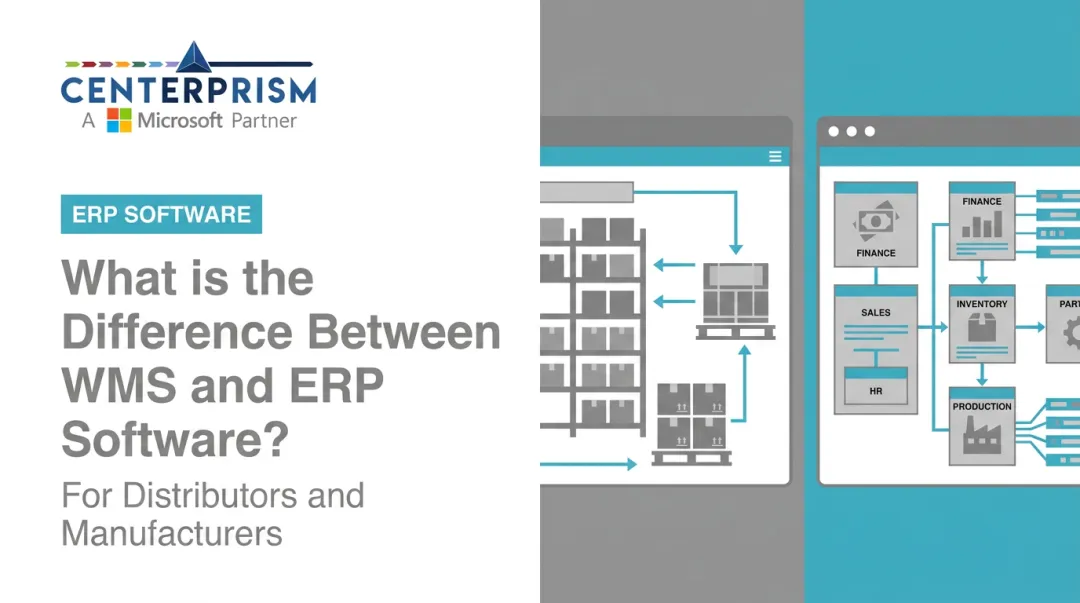
What's the difference between WMS and ERP?
An ERP runs broader processes such as finance, purchasing, sales and customer records. A WMS controls warehouse execution in more depth. Some ERPs include warehouse modules; others integrate with standalone WMS products.
What software is commonly used in warehouses?
Common tools include WMS, ERP warehouse modules, order management, transportation management (TMS), EDI, warehouse control systems (WCS) for conveyors and robots, and barcode or RFID applications. They work together through integrations.
What does WMS stand for?
WMS stands for Warehouse Management System, software used to control, optimize and monitor warehouse operations.