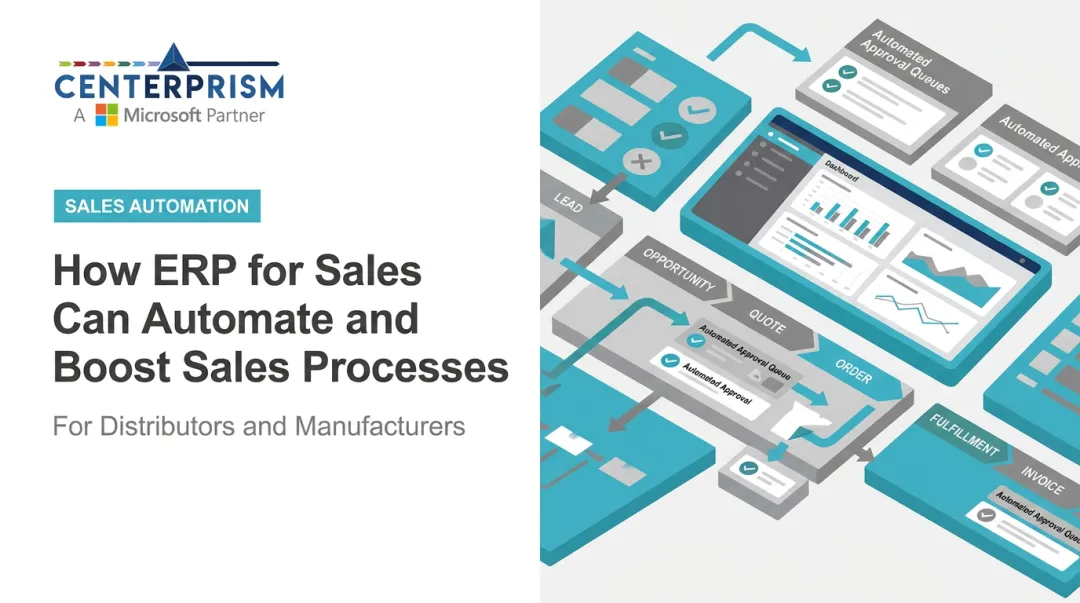

Sales automation ties customer records, product data, pricing rules, inventory, quoting and order entry together. It cuts repetitive work and leaves judgment calls to the salesperson.
This article compares five platforms: Centerprism, Epicor Prophet 21, Infor CloudSuite Distribution, NetSuite, and Microsoft Dynamics 365 Business Central with Dynamics 365 Sales. It also explains how to choose between an ERP-native platform, a distribution suite, and a standalone sales layer.
Key Takeaways
- Generic lead tracking and email sequences fall short for distributor workflows.
- Prioritize live inventory, contract pricing, quote-to-order flow, and ERP integration.
- Match the platform to your size, existing systems, and implementation resources.
- AI helps most with inquiries, quotes, and data entry when product and pricing data are clean.
Overview of Sales Automation Tools in the U.S. Plumbing Distribution Market
Sales automation is software that handles repetitive sales work. Oracle's definition covers account, lead and opportunity management, forecasting and order-related tasks. For a distributor, that extends to follow-up, quote creation, pricing, order capture and reporting.
Why a generic CRM falls short
A rep quoting a job needs to match fittings, valves, pipe and fixtures to a contractor's request. They also need to check stock by branch, delivery timing and that account's negotiated pricing. A CRM that can't see inventory and price lists forces reps to switch screens or call the counter.
Three tool categories
- ERP-native sales management: CRM, pricing and orders share one database.
- Distribution ERP with CRM and workflow automation: broader suites, often with more configuration.
- Standalone CRM or AI tools: flexible, but they depend on integration with inventory and order systems.
AI interest is high but maturity is low. The NAW/MDM index found 78.5% of surveyed distributors developing or piloting AI, with data quality and integration named as a barrier by 68.1%.

The tools below are compared on distributor fit, automation depth, integration, usability, scalability, support and total cost of ownership.
Best Sales Automation Tools for Plumbing Distributors in the United States
Selection criteria: wholesale distribution relevance, quote and order automation, inventory and product data access, pricing controls, CRM, integrations, reporting, implementation effort, and fit for small and mid-size teams.
1. Centerprism Full Spectrum ERP
Centerprism is a distribution ERP for small and mid-size wholesale distributors of durable goods, including plumbing supply. It is built on Microsoft Dynamics GP, so existing GP distributors can modernize without starting over. Orders, inventory, pricing, purchasing, CRM and sales sit in one database rather than stacked add-ons.
Standout features:
- PrismView analytics connects to the live database with no separate BI database
- Real-time sales trends, best sellers and margins without spreadsheet exports
- Customer-specific, contract and volume pricing applied automatically at order entry
- CRM built into the ERP, tracking notes, activities, purchase history and automated receivables follow-up
- Vendor price-file imports instead of manual keying
- Custom sales plans and flexible commissions for each salesperson
- Plumbing edition with counter POS, contractor pricing, backorder status and multi-location stock
Best fit: Plumbing distributors with roughly 5 to 50 users who want ERP-native sales management.
Sales automation capabilities:
- Quotes through invoicing, including picking, fulfillment and backorders
- Rule-based configurator guiding staff through complex items
- Mobile access for outside reps to customers, pricing, inventory and order status
- Receivables automation and commission calculations
Integration, implementation and considerations:
- Runs on your own server, a managed data center, Azure or AWS
- Fixed-fee implementation, traditional licensing and annual support
- U.S.-based support where a person answers the phone
- Tied to Dynamics GP, so confirm that foundation fits your long-term plans
2. Epicor Prophet 21
Epicor positions Prophet 21 as ERP for wholesale distribution. Its materials cover distribution sales and CRM, quotes and orders, inventory and pricing, with mobile access and a cloud deployment option. It suits mature, multi-branch distributors with complex product and pricing management.
Best fit: Larger or multi-branch distributors needing a mature platform. Confirm user range and operating model with Epicor.
Sales automation capabilities:
- CRM tools for customer interactions and sales activity
- Quote-to-order, inventory and pricing functions
- Machine-learning inventory forecasting, which is an inventory-planning feature rather than autonomous selling
Integration, implementation and considerations:
- Request a scoped quote; Epicor does not publish a public U.S. rate card
- Epicor's Prism AI launch was announced for Latin America, so verify U.S. availability
- Ask for a plumbing-specific U.S. customer reference before you commit
- Smaller teams should weigh implementation complexity
3. Infor CloudSuite Distribution
Infor positions CloudSuite Distribution as a cloud suite for small, mid-size and enterprise distributors. It covers order-to-promise fulfillment, inventory and warehouse visibility, pricing, finance and supply chain.
Plumbing-relevant customers include Porter Pipe & Supply in Illinois, which upgraded to the platform, and First Supply, which serves plumbing, HVAC and waterworks (its case study also includes Infor WMS).
Best fit: Multi-location distributors with broad catalogs and complex purchasing, and a cloud-first preference.
Sales automation capabilities:
- Announced AI agents: product identification from a photo, plain-language quoting, and RFQ/PO conversion into quotes or orders
- Pricing and omnichannel order workflows
- Confirm whether a native CRM module is included before you sign
Integration, implementation and considerations:
- Confirm which AI features are enabled in your license
- Expect configuration for plumbing-specific workflows
- No public U.S. pricing; request itemized modules, hosting and integration scope
4. NetSuite
NetSuite combines cloud ERP and CRM. Oracle's materials describe opportunity and quote management, forecasting, order management, fulfillment and commissions, plus customer-specific price levels and quantity-based pricing. It appeals to growing distributors wanting one cloud ecosystem.
Best fit: Growth-stage distributors, especially those with multiple entities, that prefer a cloud-first platform.
Sales automation capabilities:
- Lead and opportunity tracking, quotes, orders and dashboards
- Workflow rules and inventory visibility
- Oracle's NetSuite Next rollout adds Ask Oracle and other AI features; confirm availability and edition
Integration, implementation and considerations:
- Don't assume SuiteCommerce or connectors are in the base price
- Plumbing-specific workflows may need configuration, extensions or partners
- Ask for a quote that separates licenses, implementation, data conversion, integration, training and support
5. Microsoft Dynamics 365 Business Central with Sales
Dynamics 365 Sales is the CRM application. Business Central handles order processing, inventory and finance. Microsoft's integration synchronizes selected records, and sales staff can use Business Central price lists and check availability.

Best fit: Microsoft-centered shops with partner or internal resources for configuration.
Sales automation capabilities:
- Account and opportunity management in Sales; quotes, orders and inventory in Business Central
- Power Automate, Power BI and Dataverse connections
- A Sales Order Agent that prepares quotes and orders from a mailbox with human review; verify rollout and licensing
Integration, implementation and considerations:
- Published U.S. list prices: Business Central Essentials $80 and Premium $110 per user/month; Dynamics 365 Sales Professional $65, Enterprise $105 and Premium $150. These are separate products, so add them up
- Other Dynamics 365 apps that alter Sales data models can break the standard integration
- Test plumbing-specific distribution functionality before buying
How We Chose the Best Sales Automation Tools
We weighted operational fit over brand recognition. Test every tool against your real workflows, not a canned demo.
Workflow coverage
Evaluate coverage across the full sales cycle:
- Inquiry capture and product search
- Quoting with customer-specific pricing
- Availability checks and order conversion
- Follow-up, commissions and reporting
Build a test scenario from representative pipe, fitting, valve, fixture and replacement-part orders.
Data and integration quality
For each connector, record whether it is native, API-based, partner-built or dependent on middleware. Test sync direction, frequency and error handling.
DSG's 2026 CRM report found only 16% rated contact data excellent and 26% rated transaction history excellent. It names ERP integration as the strongest predictor of CRM satisfaction. That is an association, not proof of causation.
Usability and implementation
- Data migration and catalog cleanliness
- Pricing-rule setup and permissions
- Training, mobile access and human approval points
- Security and support
Total cost of ownership
Compare licensing, implementation, customization, integrations, support and added users. Then measure outcomes such as quote turnaround, follow-up completion, order-entry accuracy and gross-margin visibility.
Common mistakes
- Choosing a residential field-service platform for a wholesale business
- Automating inaccurate product data
- Ignoring contract pricing
- Overlooking inventory synchronization
- Buying a standalone CRM that becomes another disconnected database
Conclusion
The best tool connects customer relationships to accurate product data, pricing, inventory, quoting, order management and follow-up. Judge platforms with real customer scenarios, your current catalog, pricing rules, branch needs, integration requirements and total cost, not feature lists alone.
If you want to explore an ERP-native approach with real-time analytics, integrated CRM, pricing and commissions, contact Centerprism at 1-800-814-6631 or info@centerprism.com.
Frequently Asked Questions
What are the best sales automation tools for plumbing distributors?
Centerprism, Epicor Prophet 21, Infor CloudSuite Distribution, NetSuite and Dynamics 365 Business Central with Sales are strong shortlist options. The right pick depends on size, existing ERP, catalog complexity, pricing needs and integration requirements.
How can AI help a plumbing company?
For distributors, AI can assist with product and document search, inquiry sorting, quote preparation, follow-up and order-entry. It should also flag pricing issues and route unusual or high-value requests to a salesperson.
What features should plumbing distributors look for in sales automation software?
Look for customer-specific pricing, inventory visibility, quote-to-order workflows, clean product data, CRM, ERP integration and analytics. Permissions and support for contractor and account-based selling matter too.
Can sales automation tools integrate with a distributor's ERP and inventory system?
It depends on the platform and connector. Verify whether customers, products, prices, inventory, quotes, orders, payments and sales activity sync in real time or on a schedule.
Is an ERP-native sales automation tool better than a standalone CRM?
ERP-native tools usually reduce data silos and improve pricing and availability visibility. Standalone CRMs can offer flexible engagement but need dependable integration with distribution systems.
How much does sales automation software cost for a plumbing distributor?
Cost varies by users, modules, deployment, integrations, migration, customization and support. Request an itemized total-cost estimate rather than comparing subscription prices alone.