
That gap quietly erodes margin, creates friction when salespeople defend the difference, and weakens customer trust. The cost pressure is real. In the 2Q26 Baird-NAW survey, 91% of distributors said they respond to cost pressure by raising prices.
Distribution pricing is the system a wholesale distributor uses to set what it pays suppliers, what it charges business customers, and which account-specific rules apply in between. This guide covers core price types, the major strategies, how to build pricing rules, and how ERP technology applies them consistently.
Key Takeaways
- Price from cost, customer value, order volume, competition and cost to serve.
- Build list, net and floor prices first, then layer contract, volume and promotional rules.
- Markup and margin are different numbers; include freight, handling and returns.
- Centralize rules and approvals so the intended price shows up at order entry.
Distribution Pricing Fundamentals for Wholesale Distributors
What does distribution pricing mean?
Distribution pricing covers the prices a distributor pays suppliers and the prices it charges retailers, contractors, dealers and other commercial buyers. Unlike a retail shelf price, B2B prices are negotiated, tied to repeat accounts, shaped by wide product assortments, and affected by freight and different service expectations.
The price architecture: list, net and floor prices
- List price: the baseline or catalog price.
- Net price: what the customer pays after discounts and agreements.
- Floor price: the lowest commercially acceptable price once relevant costs are counted.
Bain's B2B pricing work uses a similar waterfall from list to net, and NAW describes override bands and floors as controls on margin leakage. Customer-specific, contract, volume, rebate and promotional rules sit on top of this structure. Without a floor and clear precedence, rules conflict and unauthorized discounts slip through.
Markup, margin and the true cost of serving an order
- Markup % = (selling price − unit cost) ÷ unit cost
- Gross margin % = (selling price − cost of goods sold) ÷ selling price
Hypothetical example: a fastener kit costs $80 and sells for $100. Markup is 25% ($20 ÷ $80). Gross margin is 20% ($20 ÷ $100). Same transaction, two percentages. Confusing them leads to underpricing.
Gross margin also overstates what you keep. Landed cost, freight, warehouse handling, delivery, payment processing, returns, repairs and service commitments all reduce order profitability.
MDM's cost-to-serve factors include:
- Order size and line count
- Payment time
- Will-call versus delivery
- Same-day delivery and returns
A single-line, same-day delivery can lose money at a price that looks fine on paper.

Distributor versus wholesaler
The terms overlap. In Census usage, a distributor is generally a merchant wholesaler selling on its own account, while "wholesaler" is the broader sector label.
Distributors often add inventory availability, technical support, delivery, configuration, repair or field service. Usage varies by industry and supply-chain role, so treat it as a convention, not a legal or commercial rule.
Pricing compliance and resale-price considerations
Supplier purchase pricing and your resale pricing are separate issues. Resale-price rules differ by jurisdiction:
- Federal law applies the rule of reason to minimum resale-price restraints (Leegin, 2007) and maximum ones (State Oil v. Khan, 1997).
- Some states treat minimum-price arrangements differently. Maryland's statute, for example, calls them an unreasonable restraint of trade.
- The Robinson-Patman Act addresses price discrimination that harms competition, and cost justification is a recognized defense.
This is general information, not legal advice. Consult qualified counsel on agreements, price restrictions, territory arrangements and other competition-law questions.
Common Distribution Pricing Strategies and When to Use Them
Cost-plus pricing
Add a defined markup to product cost. Use it for standardized or commodity items when speed of administration matters more than fine-tuned margins.
It ignores customer-perceived value, competition and cost-to-serve differences. MDM notes that a standard cost-plus margin may not capture variation in distributor cost to serve.
Competitive pricing
Distributors position prices using competitor quotes, market references or supplier guidance. McKinsey's 2019 survey of more than 200 distribution customers found price mattered most in winning deals on key-value items, roughly the top 20% of products.
That justifies sharp pricing on KVIs, not blanket matching. If your availability and delivery are better, a price war gives away what you've earned.
Value-based pricing
Price from customer outcomes such as availability, technical expertise, reliability and fast fulfillment. An HVAC contractor with a crew waiting on a job will pay more for a compressor in stock today than save a few dollars on one arriving next week.
Bain's B2B framework recommends using customer research and past buying behavior to find features worth a premium.
Volume-based or tiered pricing
Quantity breaks encourage larger orders, improve purchasing efficiency and move inventory. Test each tier: does it earn incremental volume, or discount a purchase the customer would have made anyway? Weigh it against order size and line-count costs.
Contract and customer-specific pricing
Negotiated rates support key accounts, recurring purchases and bid agreements. Operational risks include expired contracts, conflicting discounts, unauthorized overrides and scattered price records.
NAW reported SPARXiQ analysis of one large distributor where only 53% of sales were correctly priced and 48% of off-contract sales should have been on contract. That is one case, not an industry benchmark.
Promotional and dynamic pricing
- Promotional pricing applies a temporary incentive for demand generation, new accounts, seasonal activity or excess inventory; repeated discounts reset customer expectations
- Dynamic pricing responds to cost, demand, supply, seasonality or competitors and needs reliable data, approval rules and careful customer communication
McKinsey describes a building-materials distributor that cut manual overrides 80% and expanded margins by more than 200 basis points with data-led pricing. Treat it as one reported case.

How to Build a Profitable Distribution Pricing Strategy
Audit the current pricing position
Review actual selling prices, supplier costs, discounts, rebates, freight, returns and gross margin by product, customer, salesperson and order type. Look for:
- Margin leakage and outdated price files
- Unprofitable accounts
- Frequently overridden prices
- Products whose costs rose with no price update
Segment products and customers first
Pricing differs by product role, differentiation, lifecycle stage, order frequency, customer value, volume, service needs and competitive intensity. NAW's maturity model describes matrices that relate margin to customer segment, size and geography, and to vendor or product family.
Build practical segments, not a manual exception for every account. Keep individual treatment only where a contract truly requires it.
Apply the 5 C's
A practical version covers customer, cost, competition, channel and company.
- Customer: what the account values and will pay for
- Cost: landed cost plus cost to serve
- Competition: alternatives available to the buyer
- Channel: economics of how the product reaches the customer
- Company: goals, capacity and inventory position
The framework keeps you from pricing on cost alone.
Set price floors, discount limits and approval rules
- Set minimum margin or floor-price rules by segment.
- Assign discount authority by role, with escalation paths.
- Require documented reasons for exceptions.
- Define handling for contract renewals, vendor cost increases, freight changes and promotion end dates.
- Route manual override requests through approval, not memory.

Measure results and review trigger events
Track these metrics:
- Realized margin and price realization
- Discount frequency and override rates
- Quote-to-order conversion
- Volume by tier and contract compliance
- Profitability by customer or SKU
Schedule regular reviews, plus trigger-based ones after cost changes, competitive shifts, supplier price-file updates, inventory problems or unexplained margin slippage. Avoid a universal margin target; compare against benchmarks specific to your category.
How to Operationalize Pricing Across the Business
Connect pricing rules to order entry and ERP
List, net, floor, contract, customer-specific and volume prices belong in one controlled system, applied automatically at quote or order entry. NAW notes that spreadsheets and disparate software create problems in complex, volatile distribution. Relying on spreadsheets, old emails and salesperson memory leads to inconsistent quotes, slow processing, invoice disputes and hidden leakage.
Use real-time data to support pricing decisions
Connect pricing to live operational data:
- Current costs and vendor price files
- Inventory availability
- Sales history and customer purchase history
- Margin reporting
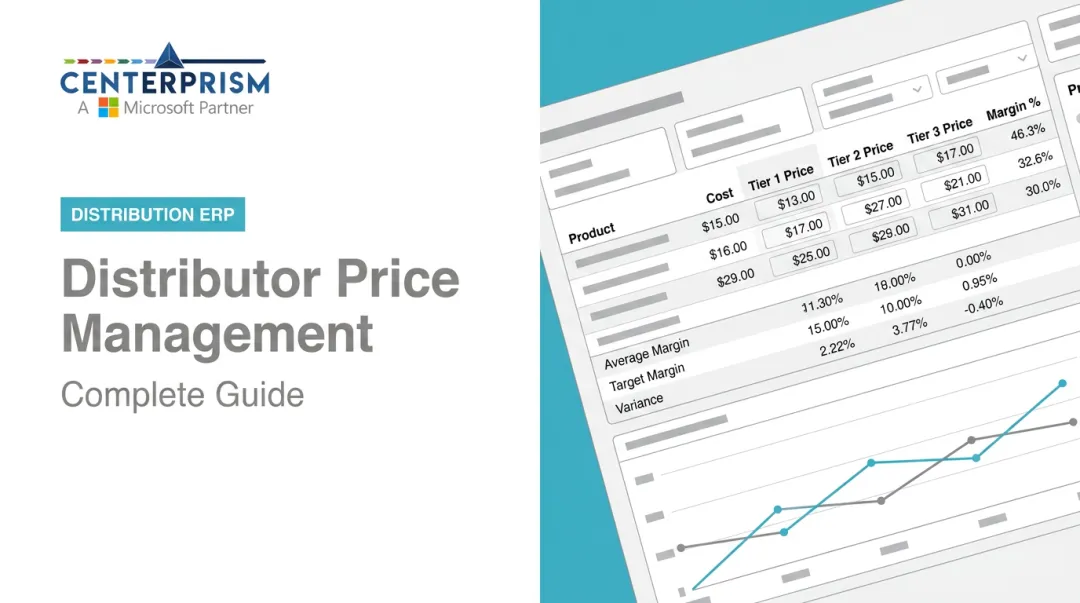
Centerprism, an ERP built on Microsoft Dynamics GP for small and mid-size durable-goods distributors, is one example. Its Price Management applies customer-specific, contract and volume pricing at order entry, memorizes each customer's historical prices for repeat orders, and imports vendor price files instead of keying them.

PrismView shows sales trends, best sellers and profit margins from live GP data, with no separate database or spreadsheet export that goes stale.
Establish ownership and pricing discipline
- Involve sales, finance, purchasing, operations and leadership.
- Name one accountable owner for the pricing program.
- Document who can create, approve, change, expire and audit rules.
Without that, rules drift as products, vendors and agreements change.
Conclusion
Effective distribution pricing is a controlled framework that matches price to cost, customer value, market conditions and order economics. A single markup applied everywhere rarely fits every customer or order.
Put the framework into practice:
- Start with a pricing audit
- Define floors and approval rules
- Test a focused set of changes
- Automate the rules that consistently protect profitable growth
Frequently Asked Questions
What is distributor pricing?
Distributor pricing is the set of prices used when buying from suppliers and reselling to business customers. It typically includes list, net, contract, volume and promotional pricing.
What does "distribution pricing" mean?
Distribution pricing is the broader process of setting, managing and reviewing prices across products, customers, channels, costs and market conditions.
What percentage does a distributor take?
No universal percentage exists. Economics vary by category, competition, inventory risk, service level, freight, customer segment and operating costs. The U.S. Census Bureau publishes gross margin as a percent of sales by wholesale category.
What is the difference between a distributor and a wholesaler?
The terms often overlap. Distributors may add inventory management, technical support, delivery or market coverage depending on the industry.
What are the four types of pricing?
Classifications vary. Commonly discussed approaches are cost-plus, competitive, value-based and volume-based pricing. These are strategies, not fixed price types like list, net and floor.
What are the 5 C's of pricing?
Commonly customer, cost, competition, channel and company. Naming varies by source; OpenStax lists cost, customers, channels, competition and compatibility.